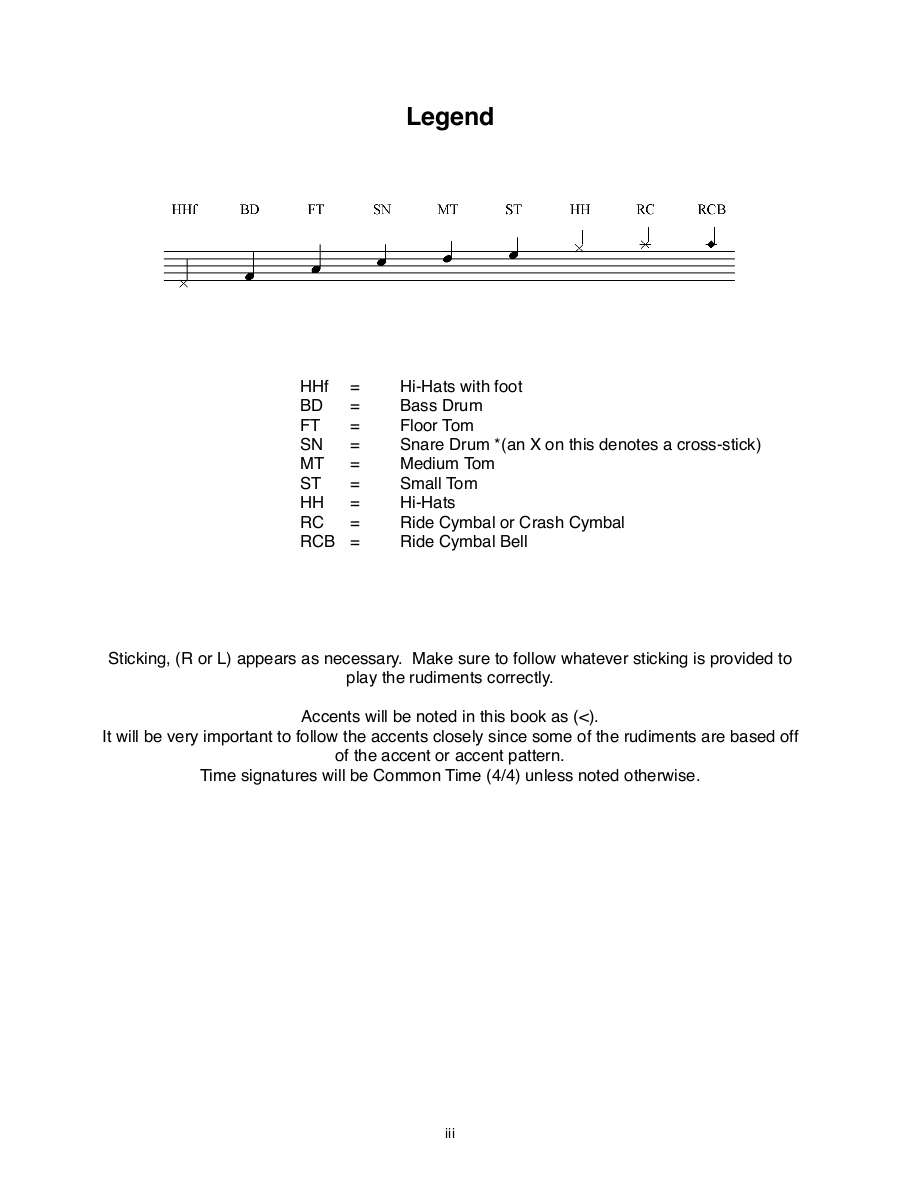
Knowing the names of the drums is one of the most essential keys to learning how to play. The teacher and student need to be able to communicate effectively and efficiently. Step one for all drum set students is reciting the names of the drums and knowing which drum they are naming. When the student knows all the names, we can add the music reading element in (See: Legend)
Drum sets can come in many configurations and sizes. For the sake of this article, we'll keep with a standard 5 piece drum set with 3 cymbals.
The bass drum (or dick drum) is the largest drum on the set. It sits on the floor and is struck by pushing your right foot down on the bass drum pedal that is attached to the batter (rear) drum hoop. It can be called a kick drum because this strike from the bass drum pedal is sometimes called a 'kick'. The large diameter of the bass drum causes it to have a low sound. This low sound puts the bass drum at one of the lowest spots on the music staff. Usually the bass drum is noted with a normal note head and placed in the lowest space (or F space).
Moving from lowest note to highest note, the next drum is the floor tom. The floor tom is one of the three tom-toms on most sets. It is called a floor tom because, very simply, it has legs and sits on the floor. It can also be called by it's head diameter. Most are 16 inches but they can run the range of 14 through 20 inches also. The floor tom also produces a low sound so it has is denoted on the lower half of the stanza as well. It generally is denoted on the second to lowest space (or the A space).
Up next, the snare drum. The snare drum is unique compared to the other drums. It's head is tighter than the other drums and it has wire (snares) that run along the bottom head of the drum. These snares produce the 'pop' sound that is known from the snare drum. The snare drum has it's own stand and sits on the immediate left of the drummer's right knee. Snare drums can range is many sizes also but the standard is for the heads to be 14 inches. The snare drum is notated in the third from bottom space of the stanze (or the C space).
Most drum sets have two rack toms, but it is not necessary to have both. My beginner's book (for instance) uses just one rack tom. Whether you have 1 or 2 is not really a big deal.
The middle tom is the tom that sits on the right side of the bass drum. It can be attached in many ways but usually is suspended atop the bass drum. It can also be many sizes but the normal size is for it to be 13 inches in diameter. The middle tom produces a higher pitched sound than the floor tom so it is placed on the second line from the top of the stanza (or the D line).
The high tom (or small tom) sits on the left side of the bass drum. It can be attached in many ways also but is mostly suspended atop the bass drum. It can have numerous sizes but the standard is 12 inches. The high tom produces a high pitch sound and is written in the highest space on the stanza (the E space).
Cymbals
Cymbals come in many shapes and sizes. The three that are considered vital to the drum set are the hi-hats, the ride cymbal, and crash cymbals.
Hi-hats are a pair of cymbals that go on a special stand that allows them to be opened and closed. The stand is placed on the left side of the bass drum so that the left foot can work the pedal. The cymbal sizes can be changed but most are 14 inches. The cymbals can be written in music in many different ways. I prefer to write the note head as an X. Usually an X on the lower part of the stanza, the bottom line (or E line) denotes a hi-hat played with just your foot while an X above the stanza (the G space) denotes a hi-hat strike with a stick.
The ride cymbal is the large cymbal (20 inches or more) that is placed on the right side of the floor tom. The ride has it's own stand and that placement can vary depending on comfort. The ride is denoted differently in many books but I prefer to put it on the line above the stanza (the A line).
Lastly, we have the crash cymbals. Crash cymbals come in many sizes and most drummers prefer to have many of them. For a beginner, it's only necessary to have one. The crash cymbal has it's own stand and the placement depends on comfort. I prefer to have at least two crash cymbals and place one on the left side of the set and the other on the right side of the set. This is not a requirement though. The crash cymbals notation can be very different from book to book. I usually use an X with a circle around it.
Having students know the names of all the drums and cymbals and where they are written on the stanza will really give them a head start in lessons, and learning in general. Up next, we'll talk about basic note reading and get you playing some simple beats.
Garrett PeekGarrett Peek is a long time stage/studio drummer and percussionist. He is the author of Beginning Snare Drum Studies, Complete Beginning Drum Set Study, & Rudiments Around the Drum Set.
Melodic Rhythms 110 North High Street, Belleville IL 62220 * 618-233-0659 * 560 North 2nd Street, Breese, IL 62230 * 618-526-7588 * www.melodicrhythms.com Career Opportunities
![[Lessons]](lessonsba.jpg)
![[Rentals]](rentalsb.jpg)
![[Repairs]](repairsb.jpg)
![[MR]](mrb.jpg)
![[AboutUs]](about.jpg)
![[Tutoring]](tutoring.jpg)
![[Videos]](videosb.jpg)



![[Register]](register.jpg)